
In many organizations, the tools already exist.
Management platforms and solutions, asset tracking, reporting systems : the technology necessary to enable thecircular economy company is widely available.
However, the implementation remains uneven.
The initiatives are moving forward slowly, or remain in the state of driver. Reuse, extending the life of the asset or the reduction of purchases are not systematized.
The brake does not therefore lie where you least expect it the most.

This blocks the prioritization
In fact, the teams arbitrate continuously between several objectives :
- meet deadlines
- secure transactions
- control costs
- meet the requirements of our customers
In this context, thecircular economy company can appear as an additional constraint.
Even when it is integrated into the strategies, it enters into competition with other operational priorities.
The result is often the same : it is recognized… but not always activated.
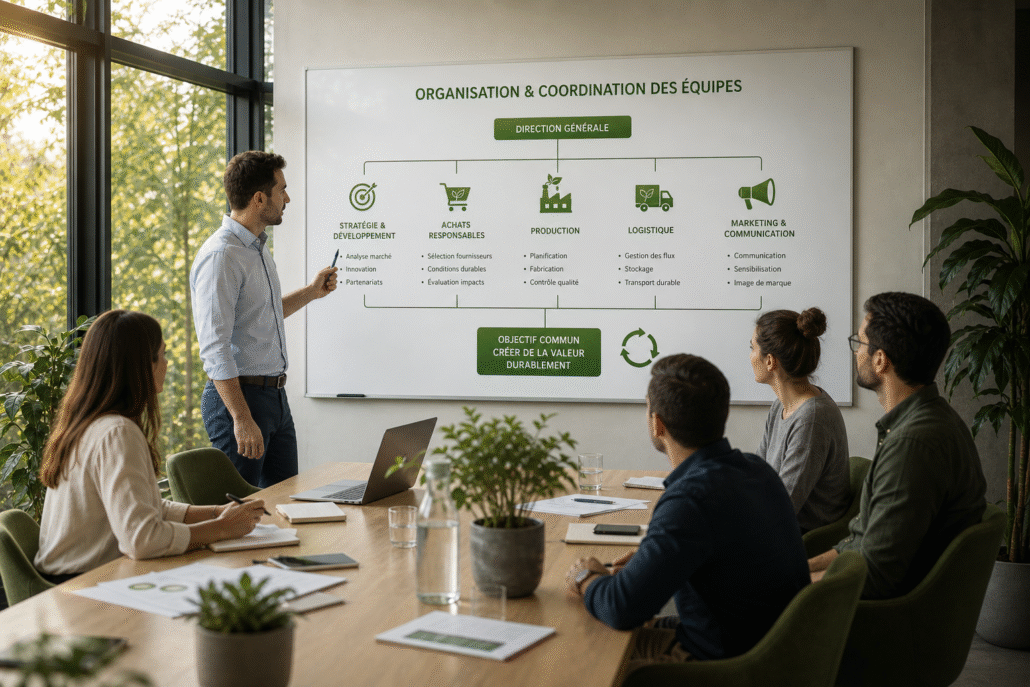
A cross-cutting subject… the owner is clear
The circular economy goes through several features :
- purchases
- operations
- finance
- CSR
But it does not belong fully to any of them.
This positioning makes its activation is more complex.
Without a clearly defined responsibility, the decisions remain fragmented. The initiatives exist, but are struggling to be structured at the scale of the organization.
As highlighted by the World Economic Forum, the transition to the circular depends largely on the ability of companies to align incentives and internal responsibilities (weforum.org).
The’circular economy business thus becomes a topic of governance before being a technical topic.
Decisions made under stress
In the operations, decisions must be fast.
When a need arises, the teams prefer the simplest and most reliable in the short term.
If the re-use requires :
- to search for information
- to coordinate several teams
- to check the availability of an asset
then the purchase is often the most straightforward solution.
This is not a lack of commitment.
It is a response to the pressure operational.
The’circular economy business is, therefore, plays in the ability to make these alternatives as simple as the purchase.
Transform the intention in the process
To overcome these limitations, organizations must integrate circularity in their existing processes.
This implies :
- make the assets visible
- simplify decisions
- reduce friction operational
- align incentives
In other words, it is not adding a new layer of complexity, but to make the existing one more effective.
The’circular economy business becomes a natural extension of the operations, and not a side project.

Operationalize the commitment
It is in this context that solutions such as CircularPlace involved.
CircularPlace allows you to structure the implementation of thecircular economy business via an asset management platform and their circulation.
By centralizing the visibility of the equipment and to facilitate their transfer or re-employment, the platform reduces the frictions that slow down the action.
It enables teams :
- quickly identify the alternatives
- to make decisions more simple
- to integrate the re-employment in their daily practices
The commitment is then based solely on the will. It becomes executable in the operations.
The real change is not technical
Companies do not need new ideas for moving forward on the circularity.
They already have :
- tools
- goals
- knowledge
The challenge is elsewhere.
👉 Make the commitment to concrete, measurable and integrated in decision-making.
The’circular economy business does not block on the technology.
It hangs on the ability to align the practices, priorities and incentives.
It is at this level that plays out the difference between ambition… and a real transformation.